Top videos

Wisdom Teeth Removal / When to extract Wisdom teeth (Third molar) / Animation // Medinaz
0:00 Introduction
0:25 What is pericoronitis
1:18 Dental caries
1:53 Damage to neighbouring teeth
2:23 Dental cyst
2:58 Dental tumor
3:29 Maxillary sinus infection - sinusitis
3:52 Orthognathic surgery
4:06 Supraeruption of third molar
Wisdom teeth removal causes:
One of the most common reason is Pericoronitis:
But what is pericoronitis?
Pericoronitis is an inflammation of the tissue surrounding a third molar. So Most people with pericoronitis wisdom tooth, have a flap of gum tissue partially covering the crown of the erupting tooth. Now this is an ideal place for the food accumulation which gives cavity-causing bacteria a place to grow.
Dentist may treat pericoronitis with gum flap removal surgery. But, if this inflammation occurs again and again then it is recommended to extract the offending wisdom tooth.
Dental caries:
Usually caries are seen in the areas of food accumulation. Now the wisdom tooth being the last one in the jaw, it is difficult to access and clean. Moreover if it the wisdom tooth is partially erupted then the chances of infection and dental caries will also increase. You may experience
pain and swelling surrounding the wisdom tooth.
Redness, swelling or bleeding gums
Bad breath
An unpleasant taste in your mouth
Difficultly in opening your mouth
Damage to a neighbouring teeth:
Due to lack of space in the jaw, the wisdom tooth may incline on the second molar. This creates pressure and then leads to damage or resorption of an associated tooth i.e 2nd molar. This also increases the chances of getting dental caries.
Dental cyst:
Dental cyst is nothing but an abnormal fluid filled sac.
If the wisdom teeth is impacted that means it has not erupted. In such situation a fluid filled sac can be formed surrounding this impacted tooth which is called as cyst. This cyst can grow and damage the surrounding bone, tissue and adjacent tooth. So in such condition the dentist will remove the cyst with the associated wisdom tooth.
Dental tumor:
Sometimes the impacted 3rd molar can be associated with dental tumor. Many times it does not cause any symptoms until it has grown to a significant size. And it can identified on radiographic examination. In such situation, the teeth will be extracted with the associated tumor.
Sinus infection (SINUSITIS):
The wisdom teeth in the upper jaw are in close proximity to the sinuses located under the cheekbones. When they start to grow in, the roots and teeth may place pressure on this area -- which can, in some cases, lead to sinus headaches or even sinus infections.
In that situation it is better to get the wisdom tooth removed.
Orthognathic surgery:
Now If your jaw is abnormally placed or if you have an abnormal jaw, then your orthodontist may plan a jaw reconstruction surgery. This is done mainly for aesthetic purpose. In such situation your wisdom teeth may be removed.
Unopposed and soon to supra- erupt tooth:
If there is absence of lower third molar or it has been extracted before, then the erupting or erupted maxillary third molar is unopposed. In such cases there is a possibility of supraeruption over time which may cause gingival tissue impingement of faulty bite. This may indicate a need for extraction of the maxillary third molar.
.
.
Medical disclaimer: Medinaz Academy does not provide medical advice. The content available in our books and videos, on our website, or on our social media handles do not provide a diagnosis or other recommendation for treatment and are not a substitute for the professional judgment of a healthcare professional in diagnosis and treatment of any person or animal. We intend to provide educational information only. The determination of the need for medical services and the types of healthcare to be provided to a patient are decisions that should be made only by a physician or other licensed health care provider. Always seek the advice of a physician or other qualified healthcare provider with any questions you have regarding a medical condition.
#wisdomteethremoval #wisdomtoothremoval #wisdomteethextraction #toothextraction #toothremoval #wisdomtooth
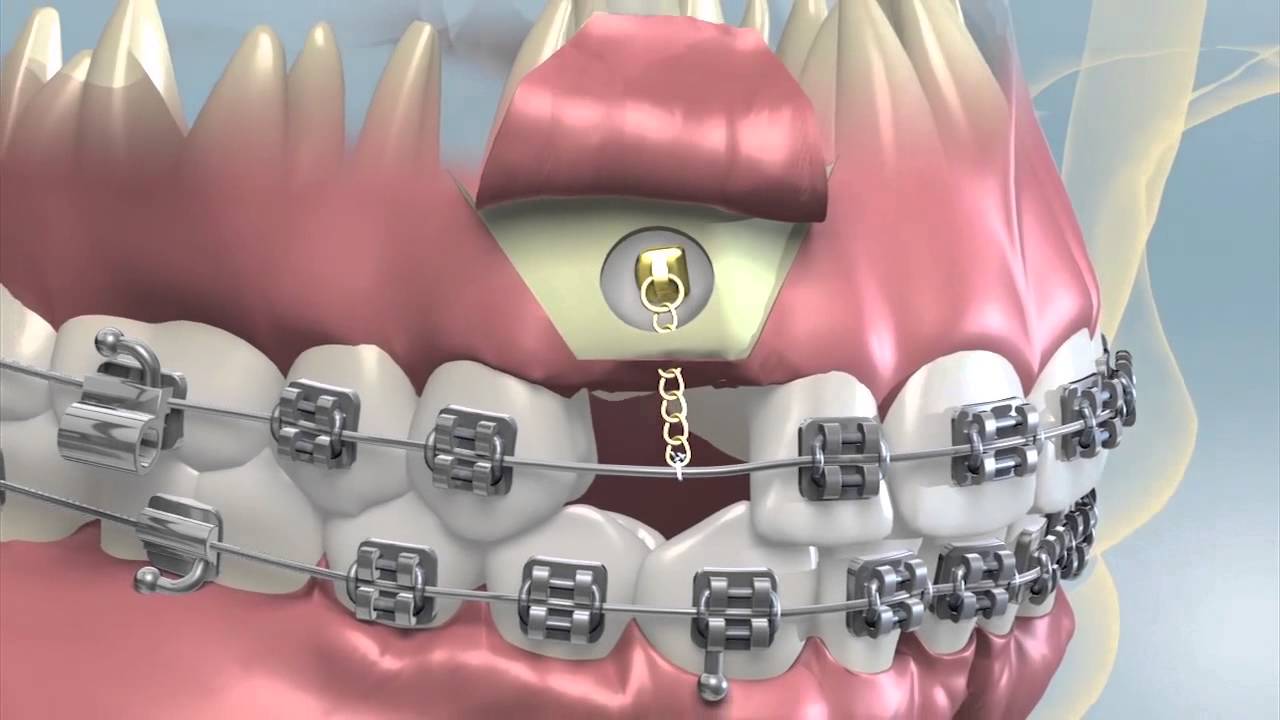
Chain and Bracket, Surgical Exposure of Impacted Tooth For Orthodontics
Although we often think of the third molars, or "wisdom teeth," when we think of impacted teeth, any of the permanent teeth can fail to erupt properly. This lack of normal tooth eruption can be due to a variety of factors such as failure of the developing tooth follicle to have the correct orientation, improper developmental timing of the tooth bud, or ankylosis of the developing adult tooth to the surrounding alveolar bone. The wisdom teeth can just be extracted and removed, but other teeth that are impacted will have a more noticeable effect on the smile's appearance and also on a patient's occlusion and function.
This is especially true of the upper canines, which are the last of the front teeth to emerge and sometimes do become impacted. Usually, they are completely obscured by the bone and visible only in x-rays.
Patients who are facing this issue can benefit from a collaborative treatment between an oral surgeon and an orthodontist. The oral and maxillofacial surgeon performs a procedure to uncover the impacted tooth, and the orthodontist moves it into place using specific appliances.
This treatment is known as a surgical tooth uncovering and chain-and-bracket procedure. The orthodontist begins the course of treatment, attaching the orthodontic appliances to the visible teeth, creating room for the unerupted tooth. Then, the patient is referred to the oral surgeon for surgical exposure of the impacted tooth and placement of an orthodontic appliance to facilitate its eruption. Sometimes the maxillofacial surgeon may need to also luxate or mobilize the tooth as well, which makes the movement required easier for the orthodontics to achieve in a more efficient manner. That surgery involves lifting the gum tissue overlying the unerupted tooth and removing any bone that may obstruct it from being moved into place. A bracket and chain are bonded to the tooth, and the chain is later connected to the rest of the braces. When everything is in place on the tooth, the gum tissue is then repositioned and sutured. This is all performed under the comfort of sedation and typically can be completed within an hour.
After taking a few weeks to heal from the procedure, patients return to the orthodontist to get the adjustments that will put tension and rotation on the tooth in order to bring it properly into position. This process may require considerable patience, as it can take up to a year for everything to be complete.
If your orthodontist has recommended a chain-and-bracket procedure as part of your treatment plan, schedule a consultation with our downtown Chicago office to learn more about the oral surgery involved in this process and whether your dental insurance plan will cover a surgical tooth uncovering.
This video was created and produced by the AAO (American Association of Orthodontists) and the AAOMS (American Association of Oral and Maxillofacial Surgeons) and explains in detail the process involved in a tooth exposure with the attachment of an orthodontic bracket and chain.


Being a registered nurse, I realize the importance of patient care and him being a doctor and a dentist, I was put at ease for the procedure.
Michael Harris, DDS, MD
David Park, DDS, MD
Jared Brown, DDS, MD
Utah Surgical Arts
http://utahsurgicalarts.com
Provo Office
3610 N University Ave, Suite 150
Provo, UT 84604
Phone: 801-356-2226
Fax: 801-812-1734
Payson Office
1107 South Hwy 198
Payson, UT 84651
Phone: 801-356-2226
South Jordan Office
11677 S 4000 W
South Jordan, UT 84095
Main: 801-477-8591
Lehi Office
139 Hunters Grove Ln, Ste 150
Lehi, UT 84043
(801) 901-8089
Serving all of Utah Counties including: Provo • Orem • Lehi • Payson • American Fork • Spanish Fork • Pleasant Grove • Salt Lake City • Highland • Alpine • Springville • Salem • Nephi • Manti • Ephraim • Heber • Bluffdale • Herriman • Draper
Services Offered: Dental Implant • Wisdom Teeth • Teeth-in-a-Day • Bone Grafting • All-on-4® • Facial & Jaw Surgery • Oral Pathology Sleep Apnea • Anesthesia • Extractions & General Anesthesia Cosmetic Surgery • Tissue Grafting

This HD video illustrates the extraction of a soft tissue impacted wisdom tooth by Dr. Calcaterra in Orange, Connecticut. With IV sedation and a non-invasive technique, our patient remembers nothing and felt no pain. She healed perfectly after this third molar extraction and was up and about only hours later.
To learn more about wisdom teeth extractions at our office in Orange, Connecticut, you can view this page: http://www.orangectdentist.com..../dental-services/wis
To learn more about IV sedation at our office visit our sedation dentistry page at http://www.orangectdentist.com..../dental-services/sed

Removal of #16 from maxillary sinus of 21 yr old female. She was quoted $8800 from OS specialist & wanted to do in hospital. She couldn't afford so I did it for $1895 in 20 minutes using GerMed Dental's new surgical kit with Anglevator & mini 150

High Quality Surgical videos and uncut stories ▶ https://surgeoncut.com
A complete video of Surgical Procedure of wisdom tooth extraction or removal for the very much cooperative patient
State of the art facial plastic surgical procedure for all ages @ Richardsons
Over 16000 successfully completed surgeries in the last decade and a half.
How do we take an appointment?
Coming over for a personal consultation with our maxillofacial surgeon, Dr. Sunil Richardson is the best option. We are located physically near the southernmost tip of India, a town named Nagercoil near Kanyakumari.
However, we have other options for patients from far and wide, who can’t travel for a direct physical consult.
The pictures can be sent to our What’s App number: +919443182860
Or emailed to drsunilrichardson@hotmail.com and appointment asked or advice sought.
We are also on most of the social media platforms :
Instagram: https://www.instagram.com/drsunilrichardson/
Twitter : https://twitter.com/facesurgeon1
Facebook : https://www.facebook.com/facesurgeon.in/
Pinterest: https://in.pinterest.com/richardsonshospital/
LinkedIn: https://www.linkedin.com/in/dr-sunil-richardson/
Tumblr: https://www.tumblr.com/blog/richardsonshospital
YouTube: https://www.youtube.com/channe....l/UC65ToDeBHrE1cSlLn
We also have a few websites...
Please visit them to get an idea about the overall work we do... in different locations.
http://www.facesurgeon.in/
www.facesurgeon.org (medical/dental tourism )
http://www.drsunilrichardson.com/arabic/( Muscat, Oman)


Removal of the tooth involves use of local anaesthesia, wherein the dentist will give a blood or a local anaesthesia or filtration to the area and he tries to remove the tooth. At the time of the removal the patient will be absolutely fine, but post removal the challenges are how he needs to take care. We tell the patient how to bite on the cotton that is given as a pack on the particular area and the patient is asked to bite that particular cotton for atleast half an hour. In a time span of atleast 2 to 3 hours there will be formation of a clot where the thrombin and the prothrombin factors in the blood will help in forming a clot. And the clot once it is formed, the bleeding will stop. As soon as the bleeding is stopped w e ask the patients not to take anything like gargle in the mouth or anything hot or anything spicy in the mouth. the only reason is if the clot in the mouth if it is disturbed, then it will lead to rebleeding and bleeding will be induced again , and the stopping of that will be very challenging. So we just tell the patient to place an ice pack over that or to have an icecream and the gelatine in the icecream makes the taste of the blood go off as well as the icepack over the particular extraction area when he rubs with the ice, the cold thing will give him a satisfied feeling for he will not like to disturb that area . We tell the patient to visit the dentist post one weeks time to see whether the bleeding is happening in a clean and neat way, failing that it will lead to a dry socket, wherein the patient will have severe pain or the particular infection happens through any smoking or drinking post extrication then the clot gets disturbed and the patient will be in severe pain and he visits the dentist an w e have to treat it with multiple antibiotics and painkillers have to be induced in the patient. Post operative acre is simple is to place a cotton pressure for half an a hour and remove it after half an hour and not disturbing he clot for 7 to 8 hour s of time and continuing his day to day habits the next day would be fine. In his case if suture is given then it would be much more easier. Wherein the food that can be restored in a day or two, and there are no much food restrictions if a suture is placed.
It was wonderful; she was crying when we got here but the staff calmed her down. Dr. Park came in and reassured her that everything was going to be smooth and that she was going to wake up feeling great and happy – she would either be crying or be silly, and everything went as smooth as we could have expected.
Michael Harris, DDS, MD
David Park, DDS, MD
Jared Brown, DDS, MD
Utah Surgical Arts
http://utahsurgicalarts.com
Provo Office
3610 N University Ave, Suite 150
Provo, UT 84604
Phone: 801-356-2226
Fax: 801-812-1734
Payson Office
1107 South Hwy 198
Payson, UT 84651
Phone: 801-356-2226
South Jordan Office
11677 S 4000 W
South Jordan, UT 84095
Main: 801-477-8591
Lehi Office
139 Hunters Grove Ln, Ste 150
Lehi, UT 84043
(801) 901-8089
Serving all of Utah Counties including: Provo • Orem • Lehi • Payson • American Fork • Spanish Fork • Pleasant Grove • Salt Lake City • Highland • Alpine • Springville • Salem • Nephi • Manti • Ephraim • Heber • Bluffdale • Herriman • Draper
Services Offered: Dental Implant • Wisdom Teeth • Teeth-in-a-Day • Bone Grafting • All-on-4® • Facial & Jaw Surgery • Oral Pathology Sleep Apnea • Anesthesia • Extractions & General Anesthesia Cosmetic Surgery • Tissue Grafting

Myiasis is the medical term for infestation of living tissues of humans and vertebrates by fly larvae. This video illustrates myiasis in a homeless man in his 50s with alcohol use disorder who sustained a lower lip injury 5 days previously; he was hospitalized and treated with regular dressings with turpentine oil and surgical debridement of the wound along with the manual removal of the larvae under local anesthesia, as illustrated in this video. See https://ja.ma/2QGvjhS for full clinical details and a case discussion.
This educational video depicts a surgical procedure and is intended for use by medical professionals.